
I woke up on Monday morning with a splitting headache. Was it going to be possible to do the work required from this exciting new learning opportunity that morning? I took some tylenol and started my morning in the hopes that it would get better. Downstairs in the kitchen, I prepared eggs and buttered toast, and hoped the headache would go away. I tried to use the coffee maker in the hopes that coffee would help, but I couldn’t get the coffee maker to make to coffee very strong. I have since decided to stick with tea. 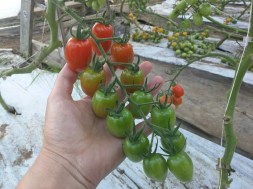
I grabbed some black nitrile gloves and went out to the greenhouse to pick a medley of bite sized tomatoes for the morning order. We always use nitrile gloves for anything to do with tomatoes because the tomatoes will leave a green-brown residue on your hands that is nearly impossible to completely wash out. We all went along our rows picking the tomatoes, several at a time and carefully placing them into white bins. The tomatoes that needed extra washing went into a small carton, and the tomatoes that could not be sold went into another. When our bins were full, we would go outside the greenhouse and empty the good tomatoes into blue slotted bins, put the extra-wash tomatoes into a separate bin, and huck the unsaleable tomatoes into the compost heap. This project took until lunchtime.
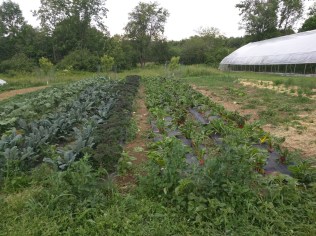
After lunch, the Head Farmer and all of the wwoofers went out to the field to pick swiss chard for a last minute order. Swiss chard is not normally picked on a hot afternoon; but the customer had called in the morning to ordered it and the Head Farmer explained that we should fill the order since the chard was ready now. He could have said no, but the chard may have become bitter and unsalable if it had waited to be sold on a later date. We thoroughly watered the chard before and during the picking process to ensure that it wouldn’t wilt in the heat. Then another wwoofer (pseudonym A), the Head Farmer, and Dil bundled up the chard for the customer.
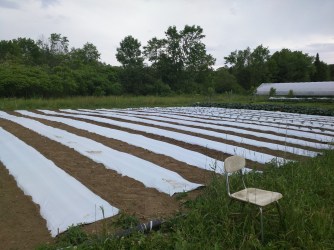
A and I were tasked with hoeing between the rows on the southmost side of the productive field. Operating a hoe was something I’d never done before. For those of you who don’t know, a hoe has a long handle like one for a shovel, with a flat-headed blade on the end, used to remove weeds and break up soil. I hoed several aisles.
Then we were all moved to the spinach beds where we were asked to meticulously weed. I was asked to hoe between the rows to get rid of the weeds. I finished before everyone had finished weed, so I crouched down to help weed. Eventually, the Head Farmer came out and inspected our work. There were still a few tiny weeds so we all stayed until 4:30pm, pulling the tiniest weeds from between the spinach. Apparently, it is crucial to pull out every single tiny weed to make the harvest process as easy as possible. If the harvester can just cut the spinach without there being any weeds in between, that really speeds up the process. There was another bed of spinach a few rows up that was not properly weeded, if it had been weeded at all (probably because of an untrustworthy wwoofer  .)
.)
Before dinner, the farm mom showed me their vast collection of books, and made several recommendations. I wish I had time to read them all, but i will likely add several of these books to my reading list for later.
Still suffering from my headache, but proud of a hard days work, I went to bed exhausted and happy!
 Dayana's Days